Skip to content
How to Turn a Cargo Van Into Your Home in One Hundred Thousand Easy Steps : ) - Part 2
The last thing on my list was installing a battery charging system to power the 'house' part of the van - refrigerator, water pump, fan, lights, heater, and outlets. This process brought me to my knees - literally and figuratively. For 3 months, from January to March 2020, I installed the appliances, wiring, and components for battery-generated power. I already knew how to wire a house, but dealing with 12V power was new to me, and frankly, this old dog didn't want to learn a new trick! But, being the die-hard do-it-yourselfer that I am (and having completely run out of money) I had to learn. A huge thanks goes out to Andy who showed me his pristine electrical system, answered my gazillion texts, and did it all with patience, kindness and a smile : )
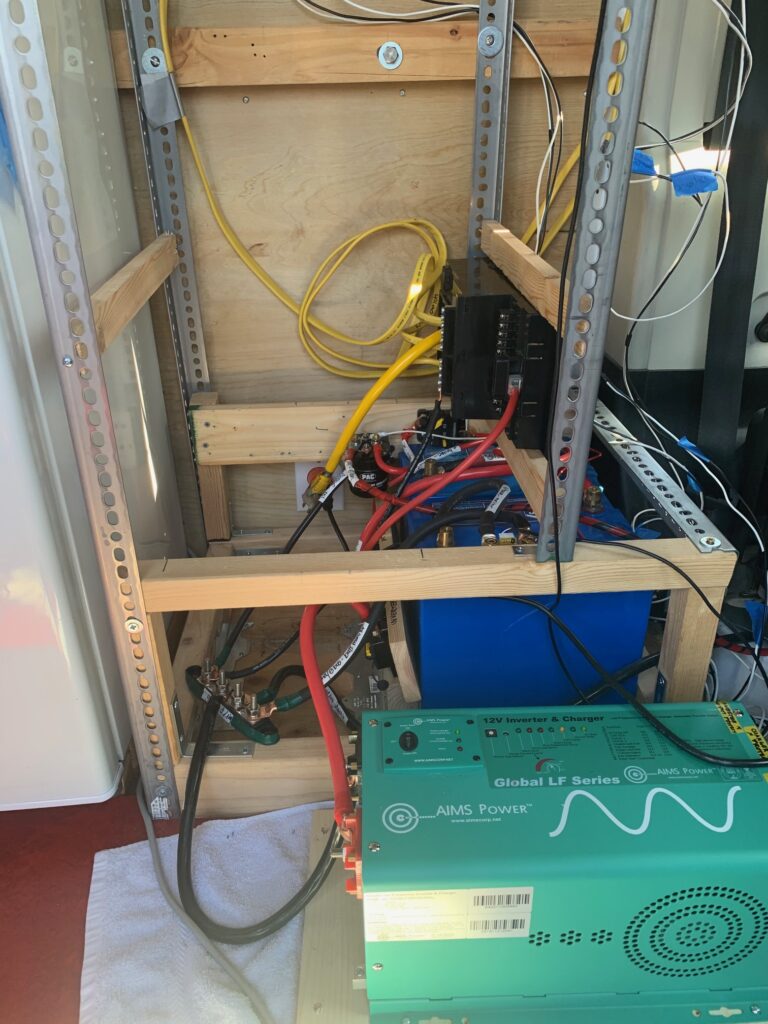
The inverter/charger - the heart of the 'house' electrical system.
Two 6V sealed batteries are connected together to create a 12V battery bank. The batteries are charged by the inverter while the van is running by connecting it to the van's engine battery charging system.
The batteries can also be charged by plugging into an exterior power source using an outlet I installed on the outside of the van.*
The inverter leads to a distribution panel where all the circuit and appliances are connected - both 12V and 120V.
The 120V system includes regular outlets for charging devices and small appliances, the water pump and the refrigerator.
The 12V system includes some lights, the ceiling fan, and charging ports.
Once I finally got everything installed and connected, my friend Andy, a fellow van converter, helped me test it. Everything worked! Flipping a switch and plugging into an outlet are true luxuries compared to running extention cords or using batteries. (And it's also nice to know you can live comfortably without such luxuries, even it it's a bit less convenient.)
Unfortunately, the refrigerator kept shutting down the inverter, even though its wattage draw was rated much less than the inverter's capacity. No amount of testing and reconfiguring would fix it. So the inverter was disconnected, removed, and returned for another model (yes, rather like a heart transplant). Once the new model arrived, a new problem arose in the form of a pandemic...
On March 14, I realized I would not be hitting the road for a planned 6-month road trip. Instead, I sheltered in place with my son in Seattle. The final work to install the new inverter has been put on hold while I ride out the pandemic with the rest of the world. Read about that process here.
*If you are wondering why I didn't use solar, it's because I couldn't fathom learning one more thing in this process. And, I wanted to live with a more basic system to see how much solar I'd really need if/when I added it. When you learn about an electrical system for a camper van, you can't help but be exposed to information on solar systems. So, I did learn a bit and have filed that information away. It won't be hard to add in the future.
Up next... nothing ever again, I hope!
Scroll To Top